
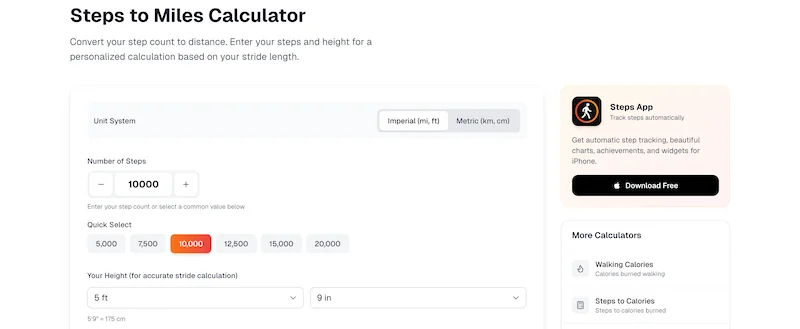
How To Convert Steps Into Distance And Calories

Learn how step length affects distance calculations, how to estimate calories burned per step, see examples for different body weights, and discover how to track distance and calories more accurately.
When you see your step count, you might wonder how far you actually walked and how many calories you burned. Converting steps to distance and calories involves some math, but understanding the process helps you set better goals and track your progress more effectively.
Here is how to convert your steps into meaningful distance and calorie data.
How Step Length Affects Distance Calculations
Your stride length is the key factor in converting steps to distance.
What Is Stride Length?
Stride length is the distance covered in one step:
Definition:
- Distance from heel of one foot to heel of same foot after one complete step
- Measured in feet, inches, or centimeters
- Varies significantly between individuals
- Changes with walking speed
Factors affecting stride length:
- Height (taller people generally have longer strides)
- Leg length
- Walking speed
- Fitness level
- Age
- Terrain
Average Stride Lengths
Typical stride lengths by height:
These are averages. Your actual stride may differ.
The Basic Distance Formula
Converting steps to distance is straightforward:
Formula: Distance = Steps x Stride Length
Example:
- 10,000 steps x 2.5 feet = 25,000 feet
- 25,000 feet / 5,280 = 4.73 miles
In metric:
- 10,000 steps x 0.76 meters = 7,600 meters
- 7,600 meters = 7.6 kilometers
The commonly cited "10,000 steps = 5 miles" is based on an average stride length of about 2.64 feet. Your actual distance may be more or less depending on your personal stride length.
How to Measure Your Stride Length
Get a more accurate conversion by measuring your stride:
Method 1: Direct measurement
- Mark a starting point
- Walk 10 normal steps
- Mark the ending point
- Measure the total distance
- Divide by 10
Method 2: Known distance
- Walk a measured distance (100 meters, 1/4 mile)
- Count your steps
- Divide distance by steps
Method 3: Height-based estimate
- Stride length is approximately 0.413 x height (in same units)
- Example: 5'8" (68 inches) x 0.413 = 28 inches (2.33 feet)
Why Stride Length Varies
Your stride changes throughout the day:
Walking speed:
- Faster walking = longer strides
- Slow strolling = shorter strides
- Brisk pace can add 20-30% to stride length
Terrain:
- Flat surfaces = normal stride
- Uphill = shorter strides
- Downhill = longer strides
- Uneven ground = variable
Fatigue:
- Fresh = longer strides
- Tired = shorter strides
- End of long walk = reduced stride
How to Estimate Calories Burned Per Step
Calorie calculations are more complex than distance.
Factors Affecting Calorie Burn
Multiple variables determine calories burned:
Body weight:
- Heavier people burn more calories
- Moving more mass requires more energy
- Primary factor in calorie calculations
Walking speed:
- Faster walking burns more per minute
- But takes fewer minutes per distance
- Moderate speed is efficient
Terrain and incline:
- Uphill burns significantly more
- Stairs burn even more
- Flat ground is baseline
Fitness level:
- Less fit individuals burn more initially
- Efficiency improves with fitness
- Heart rate indicates effort
Calories Per Step Estimates
Approximate calories burned per step by body weight:
These are estimates for moderate-paced walking on flat ground.
The MET Method
A more accurate approach uses METs (Metabolic Equivalent of Task):
What is MET:
- 1 MET = calories burned at rest
- Walking = 3-5 METs depending on speed
- Higher MET = more intense activity
MET values for walking:
- Slow walking (2 mph): 2.5 METs
- Moderate walking (3 mph): 3.5 METs
- Brisk walking (4 mph): 5.0 METs
- Very brisk (4.5 mph): 7.0 METs
Calorie formula: Calories = METs x Weight (kg) x Time (hours)
Example:
- 70 kg person walking briskly for 1 hour
- 5.0 x 70 x 1 = 350 calories
For a quick estimate, multiply your weight in pounds by 0.04-0.05 to get calories per step. A 150-pound person burns roughly 40-50 calories per 1,000 steps at a moderate pace.
Why Calorie Estimates Vary
Different sources give different numbers:
Reasons for variation:
- Different assumptions about speed
- Different formulas used
- Individual metabolism differences
- Accuracy of input data
What to expect:
- 10,000 steps burns approximately 300-500 calories
- Varies significantly by body weight
- Actual burn may differ from estimates
Examples for Different Body Weights
Practical examples help illustrate the calculations.
Example 1: 130-Pound Person
Profile:
- Weight: 130 lbs (59 kg)
- Height: 5'4" (163 cm)
- Stride length: 2.2 feet (67 cm)
For 10,000 steps:
- Distance: 10,000 x 2.2 = 22,000 feet = 4.17 miles (6.7 km)
- Calories: 10,000 x 0.035 = 350 calories
For 7,500 steps:
- Distance: 7,500 x 2.2 = 16,500 feet = 3.13 miles (5.0 km)
- Calories: 7,500 x 0.035 = 263 calories
Example 2: 165-Pound Person
Profile:
- Weight: 165 lbs (75 kg)
- Height: 5'9" (175 cm)
- Stride length: 2.5 feet (76 cm)
For 10,000 steps:
- Distance: 10,000 x 2.5 = 25,000 feet = 4.73 miles (7.6 km)
- Calories: 10,000 x 0.045 = 450 calories
For 7,500 steps:
- Distance: 7,500 x 2.5 = 18,750 feet = 3.55 miles (5.7 km)
- Calories: 7,500 x 0.045 = 338 calories
Example 3: 200-Pound Person
Profile:
- Weight: 200 lbs (91 kg)
- Height: 6'0" (183 cm)
- Stride length: 2.6 feet (79 cm)
For 10,000 steps:
- Distance: 10,000 x 2.6 = 26,000 feet = 4.92 miles (7.9 km)
- Calories: 10,000 x 0.055 = 550 calories
For 7,500 steps:
- Distance: 7,500 x 2.6 = 19,500 feet = 3.69 miles (5.9 km)
- Calories: 7,500 x 0.055 = 413 calories
Quick Reference Table
Steps App
FreeSteps App automatically calculates your distance and calories based on your step count and personal data. The app integrates with Apple Health to use your height and weight for more accurate calculations. View your daily, weekly, and monthly totals with beautiful charts that show your progress over time.
How to Track Distance and Calories More Accurately
Improve the accuracy of your tracking.
Input Accurate Personal Data
Your device needs correct information:
Essential data:
- Accurate height
- Current weight
- Age (affects some calculations)
- Gender (affects some calculations)
Where to update:
- iPhone Health app profile
- Fitness app settings
- Device settings
Update regularly:
- Weight changes affect calorie calculations
- Update after significant weight changes
- Review periodically for accuracy
Calibrate Your Device
Improve distance accuracy with calibration:
GPS calibration:
- Walk a known distance outdoors
- Device learns your stride length
- More accurate future calculations
Manual stride input:
- Measure your stride length
- Enter in device settings
- Provides consistent calculations
Apple Watch calibration:
- Go outdoors with good GPS signal
- Walk or run for at least 20 minutes
- Maintain steady pace
- Device calibrates automatically
Use GPS for Outdoor Walks
GPS provides more accurate distance:
When GPS helps:
- Outdoor walking
- Running
- Hiking
GPS advantages:
- Measures actual distance traveled
- Not dependent on stride estimates
- Accounts for route variations
GPS limitations:
- Uses more battery
- Does not work well indoors
- Signal can be blocked
GPS-based distance is more accurate for outdoor activities, but step-based calculations work better for indoor walking, treadmills, and all-day tracking where GPS would drain your battery.
Understand the Limitations
Accept that estimates are not perfect:
Inherent inaccuracies:
- Stride length varies throughout day
- Calorie formulas are approximations
- Individual metabolism differs
- Terrain affects both metrics
What matters more:
- Consistency over time
- Trends rather than exact numbers
- Relative progress
- Meeting goals
Use Heart Rate Data
Heart rate improves calorie accuracy:
How heart rate helps:
- Indicates actual effort
- Adjusts for fitness level
- More personalized calculation
Devices with heart rate:
- Apple Watch
- Fitness trackers
- Some chest straps
Improvement:
- Can improve calorie accuracy by 10-20%
- Especially helpful for varied intensity
Compare and Validate
Periodically check your device's accuracy:
Simple validation:
- Walk a measured track
- Compare device distance to actual
- Note any consistent over/undercounting
Calorie validation:
- Compare to online calculators
- Note if numbers seem reasonable
- Adjust expectations if needed
Common Questions
Addressing frequent concerns about conversions.
"Why do different apps show different calories?"
Apps use different formulas:
- Different assumptions about walking speed
- Different MET values
- Some include resting calories, some do not
- Rounding differences
Choose one app and stick with it for consistency.
"Are step-based calories accurate?"
Reasonably accurate for most purposes:
- Within 10-20% of actual for most people
- Good enough for weight management goals
- Trends are more important than exact numbers
"How many steps equal one mile?"
Depends on stride length:
- Short stride (2.0 feet): ~2,640 steps per mile
- Average stride (2.5 feet): ~2,112 steps per mile
- Long stride (3.0 feet): ~1,760 steps per mile
Average is often cited as 2,000-2,500 steps per mile.
"Do I burn more calories walking faster?"
Yes, but it is complicated:
- Faster walking burns more calories per minute
- But you cover the same distance in less time
- Net effect: slightly more calories at faster speeds
- Brisk walking can burn 20-30% more than slow walking
The Bottom Line
Converting steps to distance and calories involves your stride length, body weight, and walking intensity. While the calculations are estimates, they provide useful guidance for setting goals and tracking progress. Focus on consistency and trends rather than exact numbers, and ensure your device has accurate personal data for the best results.
Key takeaways:
- Distance = Steps x Stride Length
- Average stride is 2.0-2.8 feet depending on height
- Calories per step range from 0.03-0.07 based on body weight
- 10,000 steps typically equals 4-5 miles and 300-500 calories
- Input accurate height and weight for better calculations
- GPS improves outdoor distance accuracy
- Trends matter more than exact numbers
Use these conversions to understand your activity and set meaningful goals.
References
Free calculators for this topic
Related Posts

How Many Steps in 1 Kilometer? (Exact Count by Height)
Most adults take 1,200–1,500 steps to walk 1 kilometer. Get the exact step count for your height, see the full conversion table, and understand why stride length matters.

How Many Calories Does 5,000 Steps Burn? (By Weight & Pace)
5,000 steps burns roughly 150–250 calories for most adults. Get the exact breakdown by body weight and walking pace, plus tips to maximize every step.

How Many Calories Does 1,000 Steps Burn?
1,000 steps burns roughly 30–50 calories for most adults. Learn the exact math by weight and pace, and why those 'just 1,000 steps' micro-walks add up fast.