
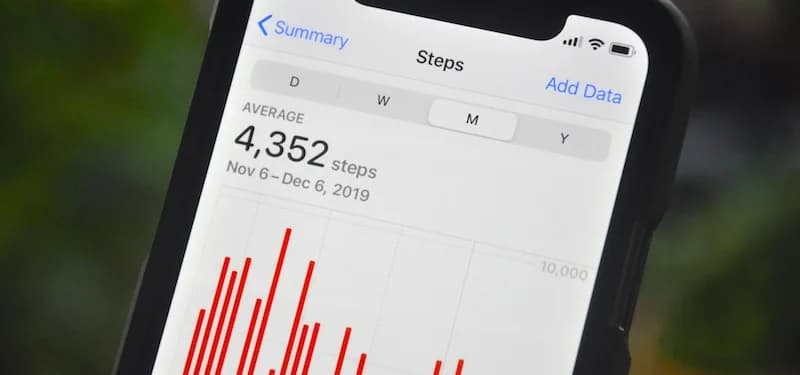
How to Set Realistic Step Goals on iPhone: Beginner's Framework

Learn why 10,000 steps might not be the right first goal, how to find your baseline, and how to set and adjust step goals using success streaks to build confidence.
Setting the right step goal is crucial for success. Too high, and you fail constantly. Too low, and you do not improve. The key is finding a goal that challenges you while remaining achievable.
Here is a framework for setting realistic step goals on your iPhone.
Why 10,000 Steps Might Not Be the Right First Goal
The 10,000-step goal is everywhere. But it may not be right for you, especially as a beginner.
The Origin of 10,000 Steps
The 10,000-step goal did not come from scientific research. It originated from a 1965 Japanese marketing campaign for a pedometer called "Manpo-kei," which translates to "10,000 steps meter."
The number was chosen because:
- It is a round, memorable number
- It sounded ambitious and motivating
- It was good for marketing
It was not based on health research.
What Research Actually Says
Recent studies provide more nuanced guidance:
JAMA Study (2020): Health benefits increase up to about 7,500 steps for older adults and 10,000 for younger adults, with diminishing returns beyond that.
The Lancet (2022): Significant mortality risk reduction occurs between 6,000 and 8,000 steps for adults over 60, and 8,000 to 10,000 for younger adults.
Key finding: You do not need 10,000 steps to be healthy. Benefits start much lower.
For many people, especially beginners, 6,000 to 8,000 steps provides most of the health benefits of walking. Starting with 10,000 as your first goal often leads to failure and discouragement.
The Problem With Starting Too High
If you currently walk 3,000 steps per day and set a goal of 10,000:
- You fail every day
- Failure becomes expected
- Motivation disappears
- You give up entirely
A goal that causes constant failure is worse than no goal at all.
The Right Approach
Start where you are, not where you want to be. Build up gradually. Celebrate progress, not perfection.
How to Find Your Baseline Steps
Before setting a goal, understand your current activity level.
Step 1: Track Without Changing Behavior
For 5 to 7 days:
- Carry your iPhone as you normally would
- Do not try to walk more
- Do not check your steps constantly
- Just live your normal life
This reveals your true baseline.
Step 2: Calculate Your Average
After a week, calculate your daily average:
Example:
- Monday: 3,200 steps
- Tuesday: 4,500 steps
- Wednesday: 2,800 steps
- Thursday: 5,100 steps
- Friday: 3,900 steps
- Saturday: 6,200 steps
- Sunday: 4,800 steps
Total: 30,500 steps Average: 30,500 / 7 = 4,357 steps per day
Step 3: Note Your Range
Also note your highest and lowest days:
- Lowest: 2,800 (Wednesday)
- Highest: 6,200 (Saturday)
This range shows your natural variation.
Step 4: Identify Patterns
Look for patterns:
- Weekdays vs weekends
- Work days vs off days
- Active days vs sedentary days
Understanding patterns helps you set realistic goals.
Your baseline is not a judgment. It is just data. Whether it is 2,000 or 8,000 steps, it is your starting point. No shame, just information.
Step-by-Step: Setting and Adjusting Your Step Goal
Now set your initial goal and plan for adjustments.
Setting Your First Goal
Formula: Baseline + 1,500 to 2,000 steps
Using the example above (baseline 4,357):
- Conservative goal: 4,357 + 1,500 = 5,857 (round to 6,000)
- Moderate goal: 4,357 + 2,000 = 6,357 (round to 6,500)
Recommended first goal: 6,000 steps
This is achievable but requires intentional effort.
Setting Your Goal in iPhone
In the Health app:
- Open Health app
- Tap Browse
- Tap Activity
- Tap Steps
- Some apps allow goal setting here
In your step tracking app:
- Open your step app
- Find Settings or Goals
- Set your daily step goal
- Save

Steps App
FreeSteps App makes goal setting simple. Set your daily target, and the app tracks your progress with a beautiful animated ring. Watch it fill as you walk, and celebrate when you complete your goal. Adjust your goal anytime as you improve.
The First Two Weeks
During weeks 1 and 2 with your new goal:
- Focus on hitting the goal most days
- Do not worry about exceeding it
- Notice what helps you reach the goal
- Identify obstacles
Success metric: Hit your goal 5 out of 7 days (70%)
Adjusting Your Goal
After 2 weeks, evaluate:
If you hit your goal 80%+ of days:
- Increase by 500 to 1,000 steps
- You are ready for more challenge
If you hit your goal 50-80% of days:
- Keep the same goal for 2 more weeks
- Focus on consistency
- Identify and remove obstacles
If you hit your goal less than 50% of days:
- Decrease by 500 to 1,000 steps
- The goal was too ambitious
- No shame in adjusting down
Long-Term Progression
Sample 12-week progression:
After 12 weeks, you have nearly doubled your baseline.
Using Success Streaks to Build Confidence
Streaks are powerful motivators. Use them strategically.
What Is a Streak?
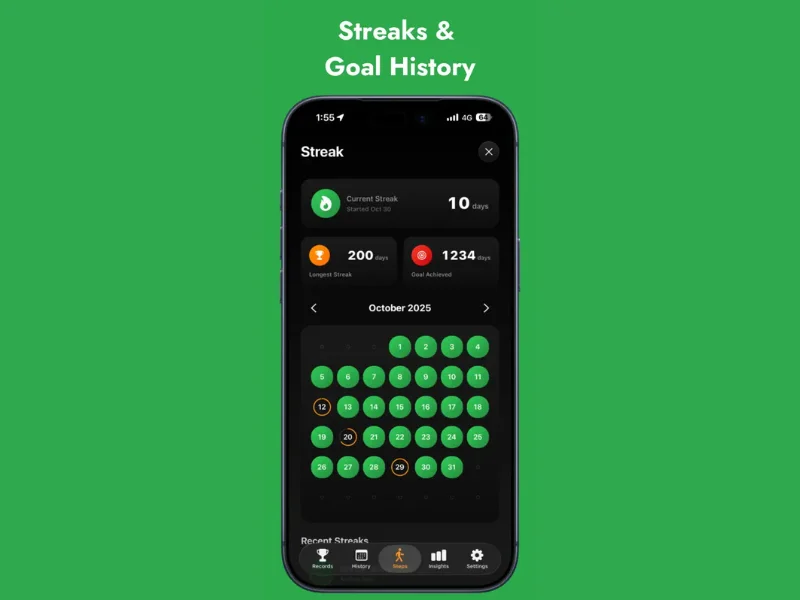
A streak is consecutive days of hitting your goal. If you hit your goal Monday through Friday, you have a 5-day streak.
Why Streaks Work
Streaks motivate because:
- Breaking a streak feels costly
- Each day adds to something you built
- Streaks create identity ("I am on a 30-day streak")
- Visible progress reinforces behavior
Setting Up for Streak Success
To build streaks:
Set an achievable goal: A goal you can hit 80%+ of days
Have a backup plan: On hard days, know how to get your steps (walk in place, mall walking, etc.)
Check progress midday: If behind, you have time to catch up
Protect the streak: On tough days, do the minimum to keep the streak alive
Do not let streak obsession become unhealthy. If you are sick or injured, break the streak. Your health matters more than any number. Start a new streak when you are ready.
Streak Milestones to Celebrate
Recovering From Broken Streaks
When a streak breaks:
- Do not catastrophize: One day does not erase progress
- Analyze: Why did it break? Was the goal too high?
- Restart immediately: Walk the next day
- Adjust if needed: Lower goal temporarily if life is chaotic
The goal is long-term consistency, not perfect streaks.
Common Goal-Setting Mistakes
Avoid these pitfalls:
Mistake 1: Starting With 10,000
As discussed, 10,000 is often too high for beginners. Start lower and build up.
Mistake 2: Never Adjusting
Your goal should evolve. If you always hit it easily, increase it. If you never hit it, decrease it.
Mistake 3: All-or-Nothing Thinking
Missing your goal by 500 steps is not failure. 9,500 steps is not worse than 0 steps. Progress matters.
Mistake 4: Ignoring Weekly Totals
Daily goals matter, but weekly totals matter more. If you average 7,000 steps over the week, it does not matter if one day was 4,000.
Mistake 5: Comparing to Others
Your friend's 15,000-step goal is irrelevant to you. Set goals based on your baseline, not someone else's.
Mistake 6: Forgetting Why
Connect your goal to something meaningful:
- "I want to be healthy for my family"
- "I want more energy"
- "I want to feel better about myself"
When motivation fades, your "why" keeps you going.
Sample Goal-Setting Scenarios
Here are examples for different starting points:
Scenario 1: Very Sedentary (2,000 baseline)
- Week 1-2: 3,500 steps
- Week 3-4: 4,000 steps
- Week 5-6: 4,500 steps
- Week 7-8: 5,000 steps
12-week target: 6,000 steps
Scenario 2: Somewhat Active (5,000 baseline)
- Week 1-2: 6,500 steps
- Week 3-4: 7,000 steps
- Week 5-6: 7,500 steps
- Week 7-8: 8,000 steps
12-week target: 8,500 steps
Scenario 3: Already Active (8,000 baseline)
- Week 1-2: 9,000 steps
- Week 3-4: 9,500 steps
- Week 5-6: 10,000 steps
- Week 7-8: 10,000 steps (maintain)
12-week target: Consistent 10,000 steps
The Bottom Line
Setting realistic step goals is about meeting yourself where you are and building from there. The 10,000-step standard is arbitrary. Your goal should be based on your baseline, increased gradually, and adjusted based on your success rate.
Key takeaways:
- Find your baseline before setting a goal
- Start with baseline + 1,500 to 2,000 steps
- Aim to hit your goal 70-80% of days
- Increase by 500 to 1,000 steps every 2 weeks if succeeding
- Decrease if you are failing more than 50% of days
- Use streaks for motivation but do not obsess
- Connect your goal to your deeper "why"
Your goal should challenge you while remaining achievable. That is how you build lasting habits.
References
Free calculators for this topic
Related Posts
How To Set Daily Step Goals On Your Phone
Learn how to set step goals in the iPhone Health app, how to set goals in other fitness apps, how to choose realistic and safe targets, and how to monitor progress each week.

How to Start a Daily Walking Habit When You're Unfit: The Complete Guide
Learn how to build a sustainable walking habit even if you're out of shape. Get a 7-day starter plan, habit-building strategies, and tips for using step goals to stay motivated.

30 Day Walking Challenge Ideas For Real Results
Discover why 30-day challenges boost motivation, get a sample beginner-friendly 30-day plan, explore fun themed challenges to try, and learn how to measure and celebrate progress.