
How Many Steps Per Day You Actually Need To Lose Weight

Discover the science-backed step counts for weight loss, how to increase your daily steps safely, and best practices to maximize fat loss through walking.
How many steps do you actually need to walk each day to lose weight? The answer is not as simple as a single number. Your ideal step count depends on your current activity level, body weight, diet, and goals.
This guide breaks down the science behind steps and weight loss, giving you practical targets you can actually achieve.
Why Steps Matter for Weight Loss
Walking is one of the most accessible and sustainable forms of exercise for weight loss. Here is why step counting works.
The Calorie Equation
Weight loss comes down to burning more calories than you consume. Walking helps by:
- Burning calories during the activity
- Increasing your daily energy expenditure
- Boosting metabolism slightly after exercise
- Reducing sedentary time
Every step you take burns calories. The more steps, the more calories burned.
NEAT: The Hidden Factor
NEAT (Non-Exercise Activity Thermogenesis) includes all the calories you burn through daily movement that is not formal exercise:
- Walking around your home
- Taking stairs
- Fidgeting
- Standing instead of sitting
For many people, NEAT accounts for 15-30% of daily calorie burn. Increasing your step count directly increases NEAT.
Why Steps Beat Gym Sessions for Many People
Walking has advantages over intense workouts:
- Lower injury risk
- No recovery time needed
- Can be done anywhere
- Sustainable long-term
- Does not increase appetite as much as intense exercise
Research shows that people who focus on daily steps often have better long-term weight loss success than those who rely on gym workouts alone.
A study in the Journal of Obesity found that participants who increased their daily steps lost more weight over 12 months than those who did structured exercise programs. The key factor was consistency.
Recommended Step Ranges Backed by Science
Here is what research tells us about step counts and weight loss.
The Baseline: Where Most People Start
The average American walks about 3,000-4,000 steps per day. This is considered sedentary and is associated with:
- Higher obesity rates
- Increased disease risk
- Lower energy levels
- Slower metabolism
If you are starting here, any increase helps.
The Health Threshold: 7,000-8,000 Steps
Research shows significant health benefits at this level:
- Reduced mortality risk
- Lower cardiovascular disease risk
- Improved blood sugar regulation
- Better mental health
For weight maintenance (not loss), this range works for many people.
The Weight Loss Zone: 10,000-12,000 Steps
For active weight loss, aim higher:
- 10,000 steps burns approximately 400-500 extra calories daily
- 12,000 steps provides even greater calorie burn
- This range creates meaningful calorie deficit when combined with reasonable eating
The Upper Range: 12,000-15,000 Steps
For faster weight loss or very active individuals:
- Greater calorie burn
- Requires more time commitment
- Diminishing returns beyond 15,000
- May not be sustainable for everyone
What the Research Says
A 2020 study in JAMA found:
- People walking 8,000 steps had 51% lower mortality risk than those walking 4,000
- People walking 12,000 steps had 65% lower risk
- Benefits plateaued around 12,000-15,000 steps
For weight loss specifically, 10,000-12,000 steps daily, combined with a modest calorie reduction, produces consistent results.
How to Increase Steps Gradually and Safely
Jumping from 3,000 to 10,000 steps overnight is a recipe for burnout. Here is how to build up properly.
Find Your Baseline First
Before setting goals:
- Track your normal steps for one week
- Do not try to walk more during this week
- Calculate your daily average
- This is your starting point
The 10% Rule
Increase by no more than 10-15% per week:
- Week 1 baseline: 4,000 steps
- Week 2 goal: 4,500 steps
- Week 3 goal: 5,000 steps
- Week 4 goal: 5,500 steps
This gradual approach prevents injury and burnout.
Sample 8-Week Progression
After 8 weeks, you will have more than doubled your starting point.
Take a consolidation week every 3-4 weeks where you maintain your current level instead of increasing. This helps your body adapt and prevents overuse injuries.
Adding Steps Throughout the Day
You do not need one long walk. Accumulate steps through:
Morning:
- Park farther from work
- Get off transit one stop early
- Take a 10-minute walk before work
Midday:
- Walk during lunch (even 15 minutes helps)
- Take walking meetings
- Use stairs instead of elevator
Evening:
- Walk after dinner
- Walk while watching TV (treadmill or in place)
- Take the dog for a longer walk
Listen to Your Body
Signs you are progressing too fast:
- Persistent fatigue
- Joint pain
- Dreading your walks
- Frequently missing goals
- Sleep disruption
If these occur, reduce your goal and progress more slowly.
Best Practices to Maximize Fat Loss with Daily Walking
Steps alone matter, but how you walk can increase fat burning.
Add Intensity Strategically
Not all steps are equal. Higher intensity burns more calories:
Brisk walking (3.5-4 mph):
- Burns 30-40% more calories than slow walking
- Elevates heart rate into fat-burning zone
- Improves cardiovascular fitness
Incline walking:
- Hills or treadmill incline
- Significantly increases calorie burn
- Builds leg strength
Interval walking:
- Alternate 2 minutes fast, 1 minute slow
- Burns more calories than steady pace
- Keeps walks interesting
Time Your Walks Strategically
When you walk can affect results:
After meals:
- Helps regulate blood sugar
- Uses calories from recent food
- Aids digestion
Morning walks:
- May burn more fat (fasted state)
- Sets positive tone for the day
- Fewer schedule conflicts
Evening walks:
- Reduces stress before bed
- Burns calories from day's eating
- Aids sleep quality
Combine Walking with Nutrition
Walking alone has limits. Pair it with:
Modest calorie reduction:
- 250-500 fewer calories daily
- Combined with walking, creates 500-1,000 calorie deficit
- Equals 1-2 pounds per week loss
Protein intake:
- Helps preserve muscle during weight loss
- Increases satiety
- Supports recovery from walking
Hydration:
- Drink water before, during, and after walks
- Dehydration reduces performance
- Often mistaken for hunger
Do not drastically cut calories while significantly increasing walking. This can lead to fatigue, muscle loss, and metabolic slowdown. Aim for a moderate combined approach.
Track Your Progress
What gets measured gets managed:
- Track daily steps
- Monitor weekly averages
- Note how you feel
- Watch for trends over time

Steps App
FreeSteps App automatically tracks your daily steps and shows weekly trend insights. Set a customizable goal that matches your weight loss target, and watch your progress over time. The visual charts help you see patterns and stay motivated as the numbers climb.
Stay Consistent Over Perfect
Consistency beats perfection:
- Walking 7,000 steps every day beats 15,000 steps twice a week
- Build the habit first, then increase
- Missing one day is fine; missing a week matters
- Focus on weekly averages, not daily perfection
Realistic Weight Loss Expectations
Set appropriate expectations to stay motivated.
The Math
To lose 1 pound of fat, you need a 3,500 calorie deficit.
Walking 10,000 steps daily:
- Burns approximately 400-500 extra calories
- Weekly: 2,800-3,500 extra calories burned
- Without diet changes: 0.5-1 pound per week
- With modest diet changes: 1-2 pounds per week
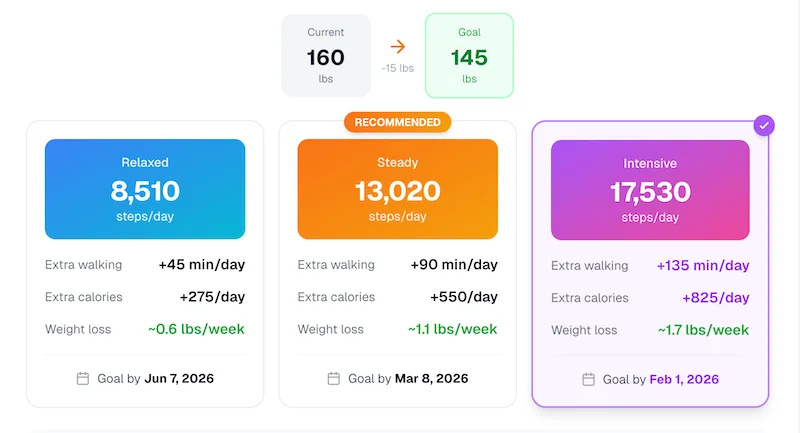
Timeline for Results
These are estimates. Individual results vary based on starting weight, metabolism, and adherence.
Beyond the Scale
Weight loss is not the only benefit:
- Improved energy
- Better sleep
- Reduced stress
- Improved mood
- Better cardiovascular health
- Stronger legs and core
These benefits often appear before significant weight loss.
The Bottom Line
The number of steps you need for weight loss depends on your starting point and goals. For most people, 10,000-12,000 daily steps, combined with modest dietary changes, produces steady, sustainable weight loss.
Key takeaways:
- Start by finding your baseline
- Increase gradually (10-15% per week)
- Aim for 10,000-12,000 steps for active weight loss
- Add intensity through brisk walking or inclines
- Combine with modest calorie reduction
- Focus on consistency over perfection
- Track your progress to stay motivated
Your weight loss journey is measured in steps. Start taking more of them today.
References
Free calculators for this topic
Related Posts

How Many Steps to Burn 500 Calories Walking?
Burning 500 calories walking takes roughly 10,000–17,500 steps for most adults. See the exact step count for your body weight and pace, plus a sample day plan.

How Many Steps to Burn 100 Calories Walking?
Burning 100 calories walking takes about 2,000–3,500 steps for most adults. Get the exact step count for your weight, plus tips to hit 100 calories faster.

Calories Burned Per Step Walking: The Exact Number
The average person burns 0.04–0.06 calories per step. See how this changes by weight and pace, and learn to calculate your personal per-step calorie burn.